

Tools
How much should you actually be eating?
Two calculators to work out your own numbers, plus a sheet to print. No sign-up. They do not replace coaching, but they show you where you stand.
Calculator
Your starting point, in numbers.
Enter your situation and everything else is calculated automatically. Every step is shown. All results are estimates, because every body responds differently.
Enter your sex, age, height and weight. Everything else is calculated instantly.
Calorie target
- Basal rate
- Total expenditure
- Adjustment
Macros
- Protein
- Fat
- Carbs
Expected progress
In the first one to two weeks your weight fluctuates because of water. What counts is the trend over three to four weeks.
Check your real progress
Enter your last morning weights, at least 14, one per line, oldest first. You see your weekly average and whether it fits your goal. The values stay in your browser.
How it is calculated
All figures are estimates based on general formulas and are not medical advice. Every person is different: metabolism, daily life, sleep, stress and training level shift the real numbers. Use them as a starting point and adjust after three to four weeks based on your real progress.
Your next step
Strength calculator
Which weight fits?
Enter one clean working set. You get your estimated one-rep max and matching weights for other rep counts. It is an estimate, so use it as a starting point for the next session.
Enter weight and reps of one set. The rest is calculated instantly.
Estimated one-rep max
- Range
- Reps to failure
- Your set as share of max
Weights at 1 RIR
The estimate gets less precise above about ten reps. Adjust by feel: if a set was easier than planned, add 2.5 kg next time.
With more than ten reps to failure this estimate is rough. A set of three to eight reps gives a better basis.
How it is calculated
Your next step
Weight only goes up when the reps behind it are clean. The article on progression shows when to add weight and when to wait.
To fill in
The training plan as a sheet.
One page for three sessions, four weeks of progression and your notes. Print it, fill it in, and you see week by week whether the load is actually rising. Free, no sign-up.
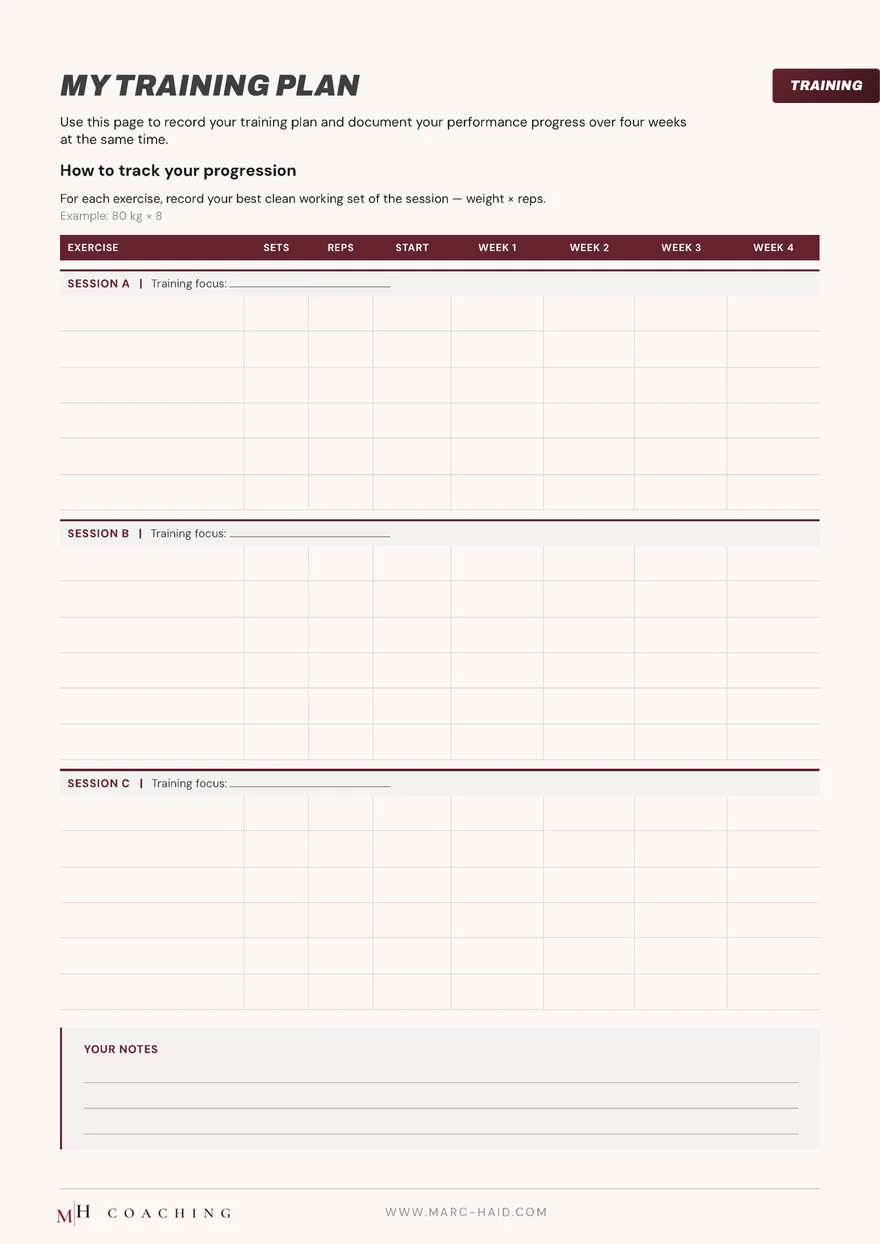
- Three sessions A, B and C, six exercises each
- Starting weight plus four weeks, as weight times reps
- Space for training focus and notes
One page, about 120 KB. Opens in every PDF reader.
In context
A calculator is not a plan.
It tells you roughly where you stand. Putting the numbers into practice is the hard part, and that is what coaching helps with.